Building a Pokedex with React and AWS
Loading...
Loading...
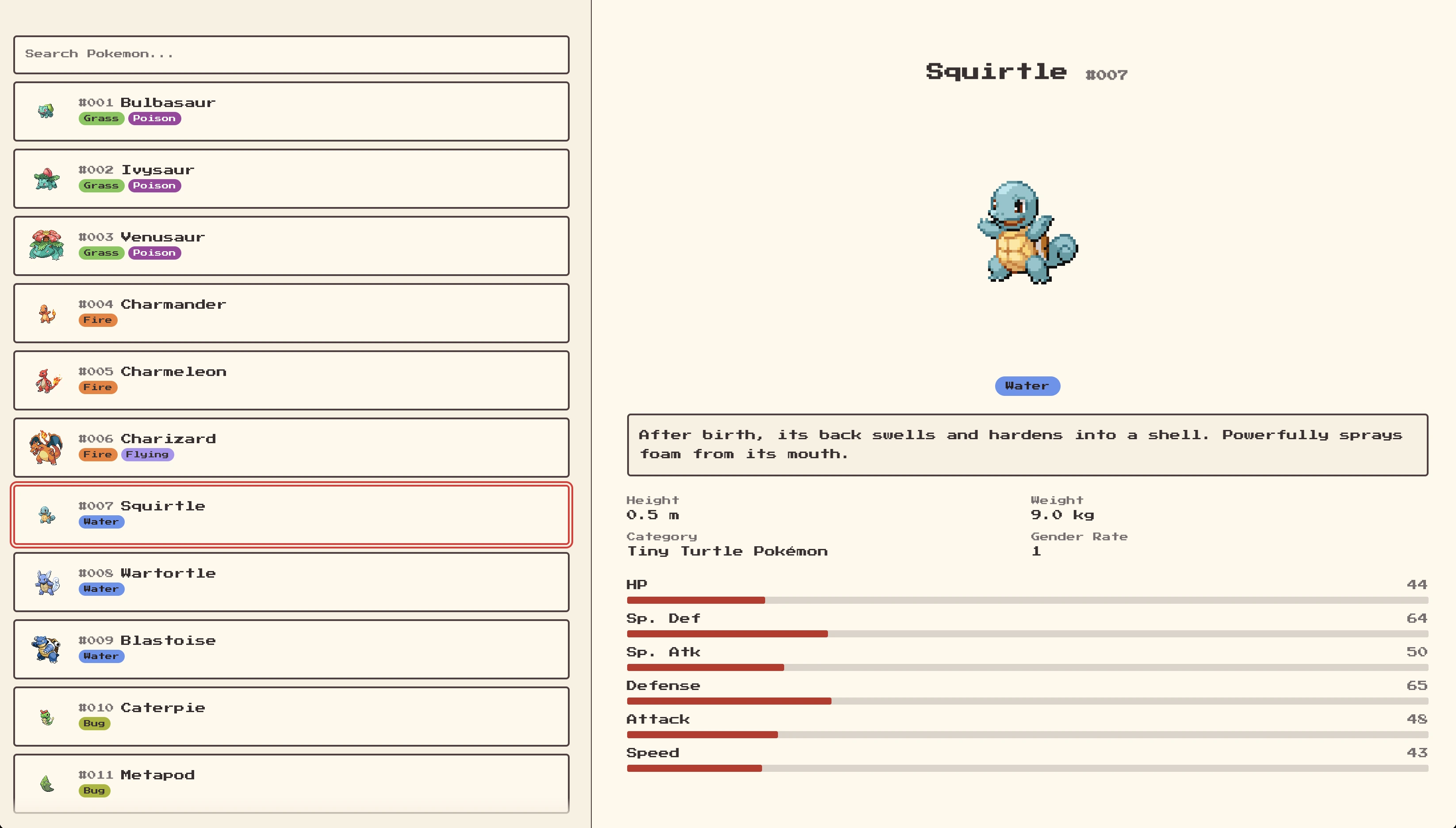
I built a full-stack Pokedex as a portfolio project. It runs on AWS, costs almost nothing to host, and looks like a Game Boy Color screen. The frontend is React 19 with TypeScript. The backend is API Gateway, Lambda, and DynamoDB, all defined in CDK.
You can try it at pokedex.akli.dev.
The infrastructure lives in a separate repo from the frontend. The Pokedex spans three of the four stacks because each has different deployment constraints.
CertificateStack deploys to us-east-1. CloudFront requires certificates in that region, so this stack owns the Route 53 hosted zone and ACM certificates. The other stacks consume its outputs through CDK's cross-region references.
PokedexStack deploys to eu-west-2. It creates the DynamoDB table, the Lambda handler, and the HTTP API Gateway. It also seeds the database automatically on every deploy (more on that below).
ApiStack also in eu-west-2. It puts a CloudFront distribution in front of the API Gateway, with a custom domain at api.akli.dev. This stack exists so I can add future APIs as additional cache behaviours on the same distribution.
The stacks reference each other through props. The CDK app wires them together:
const pokedexStack = new PokedexStack(app, 'PokedexStack', {
  env: { account, region: 'eu-west-2' },
})

new ApiStack(app, 'ApiStack', {
  env: { account, region: 'eu-west-2' },
  crossRegionReferences: true,
  apiCertificate: certStack.apiCertificate,
  hostedZone: certStack.hostedZone,
  pokedexApiUrl: pokedexStack.httpApi.apiEndpoint,
})
CDK stack dependencies are just TypeScript props. No SSM parameter lookups, no hardcoded ARNs.
The API uses HTTP API Gateway v2, which is cheaper and simpler for a read-only service like this.
A single Lambda function handles both routes. API Gateway v2 passes a routeKey string, so the handler just matches against it:
const ROUTE_LIST = 'GET /pokedex/pokemon'
const ROUTE_DETAIL = 'GET /pokedex/pokemon/{id}'

export const handler = async (
  event: APIGatewayProxyEventV2,
): Promise<APIGatewayProxyStructuredResultV2> => {
  const routeKey = event.routeKey

  if (routeKey === ROUTE_LIST) {
    const result = await client.send(new ScanCommand({
      TableName: TABLE_NAME,
      ProjectionExpression: 'id, #n, types, sprite',
      ExpressionAttributeNames: { '#n': 'name' },
    }))
    const items = (result.Items || []).map(item => unmarshall(item))
    return jsonResponse(200, { pokemon: items, count: items.length, nextToken: null })
  }

  if (routeKey === ROUTE_DETAIL) {
    const idParam = event.pathParameters?.id
    const id = Number(idParam)
    if (!idParam || isNaN(id)) {
      return jsonResponse(404, { error: 'Pokemon not found' })
    }

    const result = await client.send(new GetItemCommand({
      TableName: TABLE_NAME,
      Key: { id: { N: String(id) } },
    }))

    if (!result.Item) {
      return jsonResponse(404, { error: 'Pokemon not found' })
    }

    return jsonResponse(200, unmarshall(result.Item))
  }
}
The list endpoint uses a ProjectionExpression to return only the fields the list view needs: id, name, types, and sprite URL. The detail endpoint returns the full item. This keeps the list payload small.
The Pokedex data comes from a static JSON file checked into the infrastructure repo. I didn't want a manual "run this script after deploying" step, so I used a CDK Custom Resource to seed DynamoDB automatically.
The interesting part is change detection. CDK computes an MD5 hash of pokemon.json at synth time and passes it as a property on the Custom Resource:
const pokemonDataHash = crypto
  .createHash('md5')
  .update(fs.readFileSync(pokemonDataPath, 'utf-8'))
  .digest('hex')

new CustomResource(this, 'SeedPokemonResource', {
  serviceToken: seedProvider.serviceToken,
  properties: {
    DataHash: pokemonDataHash,
  },
})
When the hash changes, CloudFormation treats it as a resource update and invokes the seeder Lambda. When the hash stays the same, nothing happens. The seeder uses BatchWriteItem with exponential backoff, splitting the data into batches of 25 (DynamoDB's limit per request).
properties trick gives you free change detection.The frontend uses two hooks for data fetching. usePokemonList fetches all summaries on mount. usePokemonDetail fetches a single Pokemon's full data when the user selects one.
The detail hook caches responses in a useRef so clicking a previously viewed Pokemon is instant:
export const usePokemonDetail = (id: number | null) => {
  const [detail, setDetail] = useState<PokemonDetail | null>(null)
  const [loading, setLoading] = useState(false)
  const [error, setError] = useState<string | null>(null)
  const cache = useRef<Record<number, PokemonDetail>>({})

  useEffect(() => {
    if (id === null) return

    if (cache.current[id]) {
      setDetail(cache.current[id])
      return
    }

    let cancelled = false
    setLoading(true)

    const load = async () => {
      const data = await fetchPokemonDetail(id)
      if (!cancelled) {
        cache.current[id] = data
        setDetail(data)
        setLoading(false)
      }
    }

    load()
    return () => { cancelled = true }
  }, [id])

  return { detail, loading, error }
}
useRef survives re-renders without triggering them. The cancelled flag prevents state updates on unmounted components.
I wanted the app to feel like a handheld console, not a typical web app. A few CSS decisions carry most of the weight.
The pixel font is Press Start 2P, loaded as a local woff2 file. Every label, stat name, and Pokemon name uses it. The body text falls back to Courier New for readability.
Pokemon sprites use image-rendering: pixelated so they stay crisp at any size instead of getting blurry from bilinear filtering.
Each Pokemon type gets its own colour token. I precomputed the text colours to meet WCAG AA contrast ratios against their backgrounds.
Stat bars animate in with a staggered delay. Each bar receives its index as a CSS custom property, and the animation delay is computed from it:
.fill {
  width: var(--stat-width);
  animation: fillBar 300ms ease-out forwards;
  animation-delay: calc(var(--stat-index, 0) * 75ms);
}
The result: HP fills first, then Attack, then Defense, cascading down the list. The animation also respects prefers-reduced-motion.
Pagination. The list endpoint does a full table scan. With 151 Pokemon that's fine. With 1000+ it wouldn't be. The response already includes a nextToken field (always null for now), so adding cursor-based pagination with DynamoDB's LastEvaluatedKey would be backwards-compatible.
Shared types. The frontend and infrastructure repos define the same Pokemon interface independently. A shared package or a generated OpenAPI spec would keep them in sync.
End-to-end CDK tests. I unit-tested the Lambda handlers and the stack synthesis, but I didn't test the Custom Resource seeder against a real DynamoDB table. A CDK integration test using integ-runner would catch issues that unit tests miss.
You can try the Pokedex at pokedex.akli.dev.